
The Junk Drawer Challenge
The best thing I did today was open our junk drawer and hand my 4-year-old three items: a shoe lace, a binder clip, and a rubber band. Then, I told him to go see what he could invent with it. It bought me at least 30 minutes of peace to finish cooking dinner without constant requests and questions.
The systems society has designed for children don’t often ask them what they can do. They generally hand them instructions and expect them to perform a very specific task in a very specific way. Of course, instructions aren’t always a bad thing, nor is learning specific skills. But for a world that claims to value critical thinkers, we don’t leave a lot of opportunity to think outside-the-box. The message tends to be more along the lines of “Stay in this box. And if 30 minutes of playing outside isn’t enough for you to stay in the box the rest of the day, the problem is you, not the box.”
I’m far from the only parent noticing this dissonance between what we, as a society, say we want our children to be able to do, and what we know they need, versus the systems we’ve created that make it more difficult to foster those skills than it should be. It’s particularly interesting to see the amount of former public school teachers turning to homeschooling when it comes to their own children’s education. This doesn’t mean public school is all bad, but it certainly is signaling that many people close to the system and the students in it are deeming the benefits homeschooling has to offer greater than the benefits public school has to offer. One of the most glaring issues I see parents pushing back on? A devastating lack of play.
For children, play is learning, but it is also severely limited by the restrictions placed on a teacher managing a whole room of children in a single location, five days a week. That’s not to say there aren’t amazing teachers incorporating as much play as they can into their preschool and kindergarten classes. I know there are. But what is feasible in that environment cannot compare to the type of playful learning and experiences I can offer my kids without the same restrictions. Being able to play our way to teaching my oldest son how to read was one of the most amazing experiences of my life. And as a former teacher, every single day that we spend outside on a perfect fall or spring day, I remember when I was spending those perfect days in a concrete building. I’m so glad my kids are not spending their days in a concrete building. The intentionality of teaching specific skills and knowledge, in some cases being equated with the use of structured curriculums, has been somewhat demonized in the debate about what is wrong with public education. But being intentional, and even structured, in teaching our children is not a problem. As a former Ancient World History teacher, I can promise you that even if something seems irrelevant and uninteresting on the surface, it is likely more valuable and relevant to your life than you realize! The intentionality of exposing children to a wide variety of subjects and knowledge is not the problem some would like to argue it is. The problem is the limitations on how it can be done. In a system that can’t individualize as much as it would like to claim it can, play often gets left behind or severely limited.
When given the chance, play will super-charge intentional instruction. Complex play, which involves perspective-taking, problem-solving, collaboration, and rule-based play builds skills applicable beyond any particular academic topic. It activates the prefrontal cortex, engaging decision-making and planning, but also activates the amygdala, the center of our emotions, as we ride the waves that come with play: disappointment, frustration, excitement, joy. Open-ended play is deeply valuable, of course, but rule-based play also pushes the brain to creatively succeed within specific parameters. It’s a challenge to find a way to your goal even when you don’t get to do anything you want to get there. The algorithms of the internet only make space for the extremes of the world. Unfortunately, I think those algorithms are also deeply shaping where most people are having these conversations about education. But you don’t have to abandon all structure and curriculum to allow far more child-led learning into your kid’s life. You also don’t have to abandon play when you want to intentionally teach certain skills or knowledge. There can always be room for it. If there is anything my resources do for people, I hope it allows them to see the opportunities for play that abound even when teaching skills and knowledge.
Using play to intentionally teach information or practice foundational skills meets children where they are. Instead of handing down a task, you are getting down on their level and asking to be a part of their world. Children desperately want their favorite adults to want to be a part of their world. The chance to playfully connect with you makes learning something new even more appealing. Capitalize on the social, emotional, and cognitive opportunities play presents and teach far more than just academics.
Playfulness is the best motivator- use it to your advantage. Share your knowledge playfully, and also keep asking your child what they can do. Maximize your junk drawer’s potential. You never know what its treasure could become in the hands on your child.
Ideas for Your Next Playful Lesson
I naturally fell into teaching my kids playfully and once I did, they inspired endless ways to learn and play. I hope the resources they inspired me to make help you connect playfully with your own kids as you help them discover the world. The kindergarten games below are printable board games that combine the fun and mechanics of a game with valuable academic skills! I hope you find something to connect and learn with. Happy Playing!
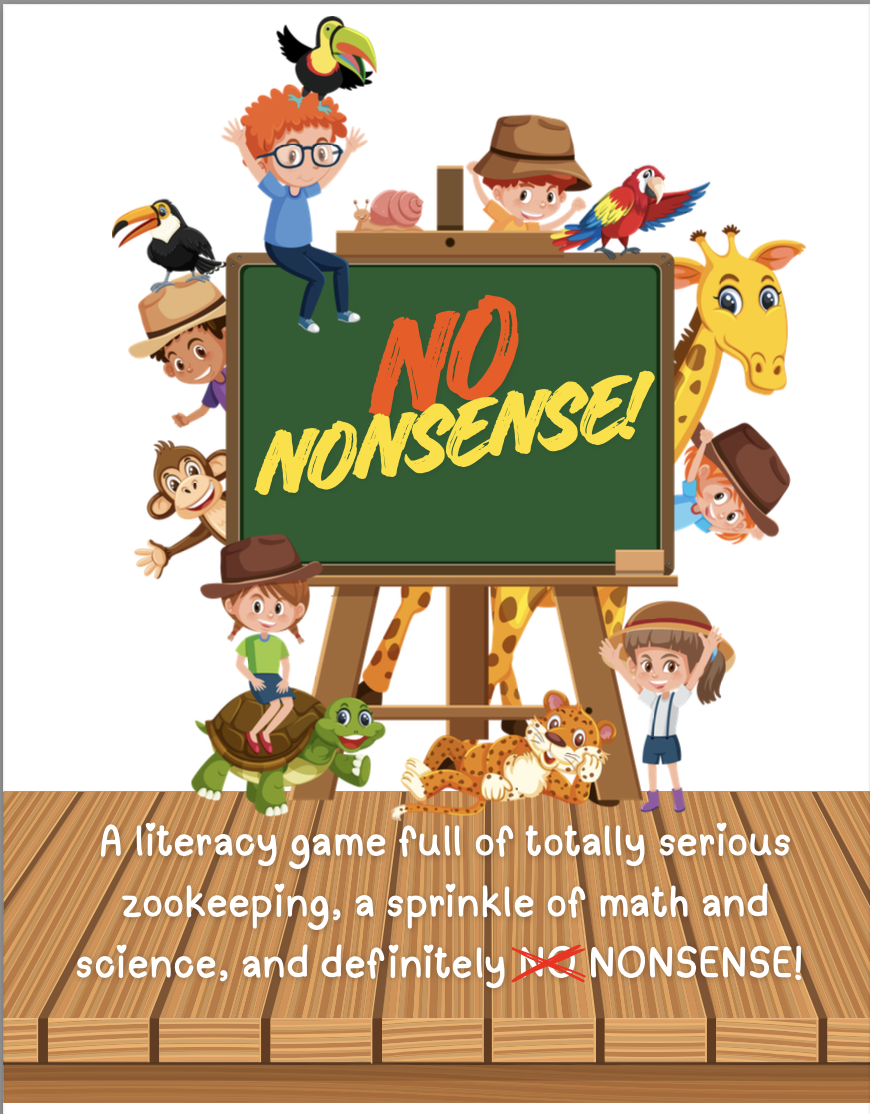
In this kindergarten level literacy game, 2-4 players try to be the first to get all of the zoo animals locked back into their cages, but only if they have a real word in the cage too! Players practice decoding real and nonsense CVC words along the way while trying to prevent the other zookeepers from filling their cages first.
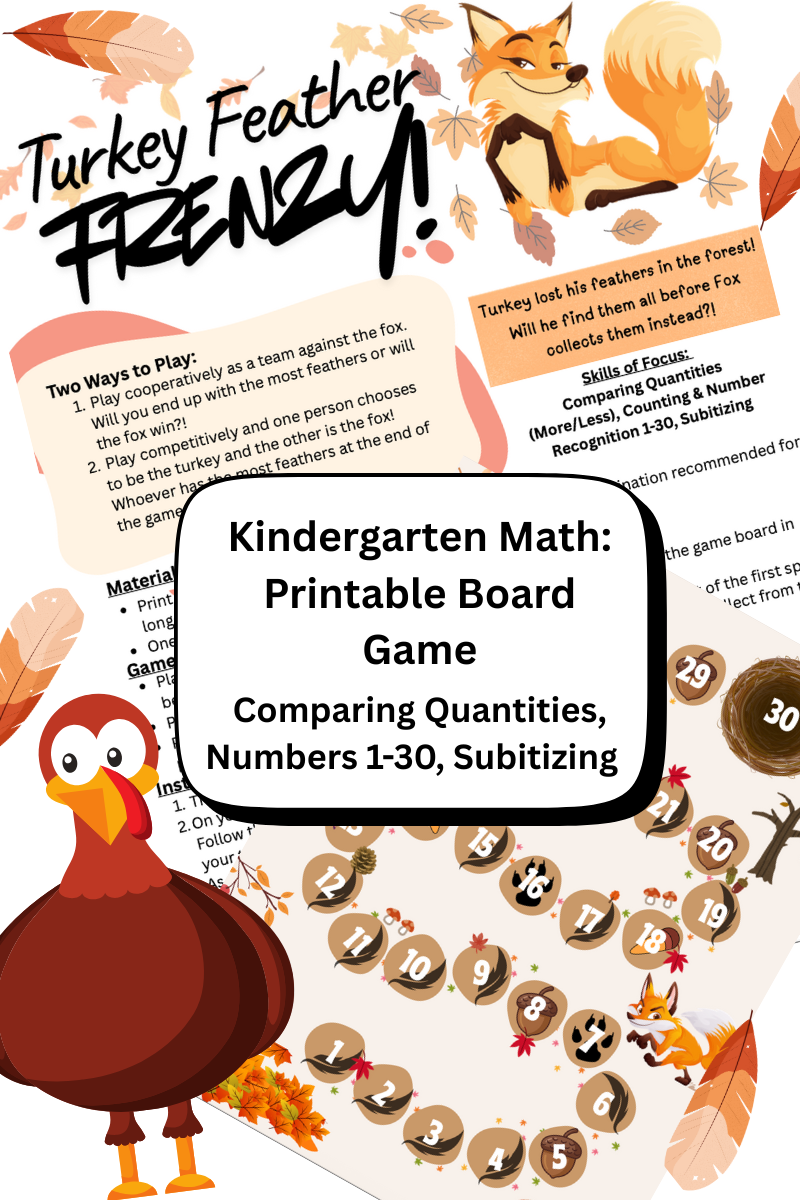
Turkey lost his feathers in the forest! Will he be able to find them all before Fox does?!
In this board game, Turkey and Fox race to find the turkey feathers as they journey through the forest. Along the way, players practice comparing quantities (more/less), subitizing, counting, number recognition of 1-30, and one-to-one correspondence skills. This game can be played competitively between two players or cooperatively as a team against the Fox. All you need is a six-sided die and everything else you need to play is included in this printable!
